


Written by Jimena Godoy, Technical Vet Service Specialist
A calf with strong passive immunity is better equipped to face the challenges of its first weeks, reducing the risk of disease and the need for antibiotic treatments. More importantly, it helps calves stay healthier, more comfortable, and better able to thrive during this critical stage of development.
For decades, dairy producers have been taught that the goal of colostrum management is to avoid Failure of Passive Transfer (FPT). While this standard dramatically improved calf health compared to previous generations of calf-rearing practices, new research has shown that simply avoiding failure is not enough.
Today, progressive dairies are shifting their focus from preventing FPT to achieving Excellent Passive Transfer, a higher standard associated with lower morbidity, lower mortality, improved growth rates, reduced treatment costs, and increased future milk production.
The difference between average and excellent passive transfer often comes down to one surprisingly simple factor: feeding enough colostrum.
A New Standard for Passive Transfer
Unlike humans, maternal antibodies are not transferred to the calf through the placenta during gestation. As a result, the newborn calf depends entirely on colostrum to acquire the immunoglobulins necessary for the first weeks of life.
Historically, the industry classified calves as successful if serum IgG concentrations exceeded 10 mg/mL. However, large-scale industry studies have demonstrated that calves continue to realize significant health and performance benefits as serum IgG concentrations increase well beyond this minimum threshold.
Today, the industry recognizes four categories of passive transfer:
- Poor: <10 mg/mL serum IgG
- Fair: 10–17.9 mg/mL
- Good: 18–24.9 mg/mL
- Excellent: >25 mg/mL
The goal is no longer to simply stay out of the failure category. The goal is to consistently place calves into the Excellent category.
Several Dairy Tech clients have demonstrated that achieving excellent passive transfer in more than 90% of calves is possible when high-quality colostrum, proper pasteurization, and consistent feeding protocols are combined with routine monitoring.
Beyond the economic benefits, providing excellent passive transfer is one of the most meaningful ways dairy producers can give calves a healthy start in life. A calf with strong passive immunity is better equipped to face the challenges of its first weeks, reducing the risk of disease and the need for antibiotic treatments. More importantly, it helps calves stay healthier, more comfortable, and better able to thrive during this critical stage of development.
As consumer and general industry interest in animal welfare continues to grow, passive transfer offers the dairy industry the most powerful example of how good management and good animal care go hand in hand. By ensuring calves receive the immunity they need from the very beginning, producers are investing not only in future productivity but also in the well-being of the animals entrusted to their care. Few management practices have such a direct, lasting, and measurable impact on a calf’s health, comfort, and quality of life.
Achieving excellent passive transfer depends on consistently getting three things right.
The Three Q’s of Colostrum Management
Quality
High-quality colostrum should contain at least 50 g/L of IgG. Equally important, bacterial contamination must be controlled because bacteria can interfere with immunoglobulin absorption in the small intestine, reducing the efficiency of passive transfer.
Research has consistently shown that properly pasteurized colostrum dramatically reduces bacterial contamination while preserving immunoglobulin integrity. As a result, calves fed pasteurized colostrum often achieve higher serum IgG concentrations than calves fed raw colostrum because more antibodies are successfully absorbed into the bloodstream.
Pasteurization may provide additional benefits beyond improved antibody absorption. Colostrum contains bioactive compounds that support intestinal development and help establish beneficial bacteria in the calf’s digestive tract. Emerging research suggests that heat treatment may improve the availability of some of these compounds, helping calves build a stronger foundation for digestive health and immune function.
Quickness
The calf’s ability to absorb antibodies begins declining almost immediately after birth.
The specialized intestinal cells responsible for transporting immunoglobulins into the bloodstream are most active during the first hours of life. As time passes, these cells begin to close, reducing the calf’s ability to absorb antibodies.
Research has shown that delaying the first feeding can significantly reduce passive transfer. For this reason, colostrum should be delivered as soon as possible after birth, ideally within the first hour of life.
The window of opportunity is short. Every hour matters.
Quantity
While quality and timing are essential, volume is often the factor that limits passive transfer on many dairies. Even high-quality colostrum cannot deliver sufficient antibodies if an inadequate volume is fed.
This is where many traditional colostrum programs fall short.
Why Two Liters Is No Longer Enough
For many years, feeding two liters of colostrum shortly after birth was considered an acceptable practice.
The problem is simple mathematics.
Assume a calf receives two liters of colostrum containing 50 g/L of IgG. That feeding provides approximately 100 grams of total immunoglobulin.
Even with excellent absorption, the resulting serum IgG concentration often places calves in the Fair category and may barely exceed historical FPT thresholds.
The calf survives, but it does not thrive.
The question is no longer whether two liters works. The question is whether two liters allows calves to reach their genetic potential.
Increasing evidence suggests the answer is no.
The Power of Feeding More Colostrum
Modern colostrum programs are increasingly focused on delivering approximately 300 grams of IgG within the first 24 hours of life.
This approach typically involves feeding approximately 15% of body weight as colostrum through two feedings.
For most Holstein calves, that means:
- First feeding: 3–4 liters within the first hour after birth
- Second feeding: 2 liters approximately 8–12 hours later
Research has shown that calves receiving additional colostrum after the initial feeding achieve higher serum IgG concentrations than calves transitioned directly to milk. Although antibody absorption declines over time, the intestine remains capable of absorbing meaningful quantities of immunoglobulins beyond the first feeding.
The implication is clear: the first feeding is critical, but the second feeding still matters.
From Adequate to Excellent
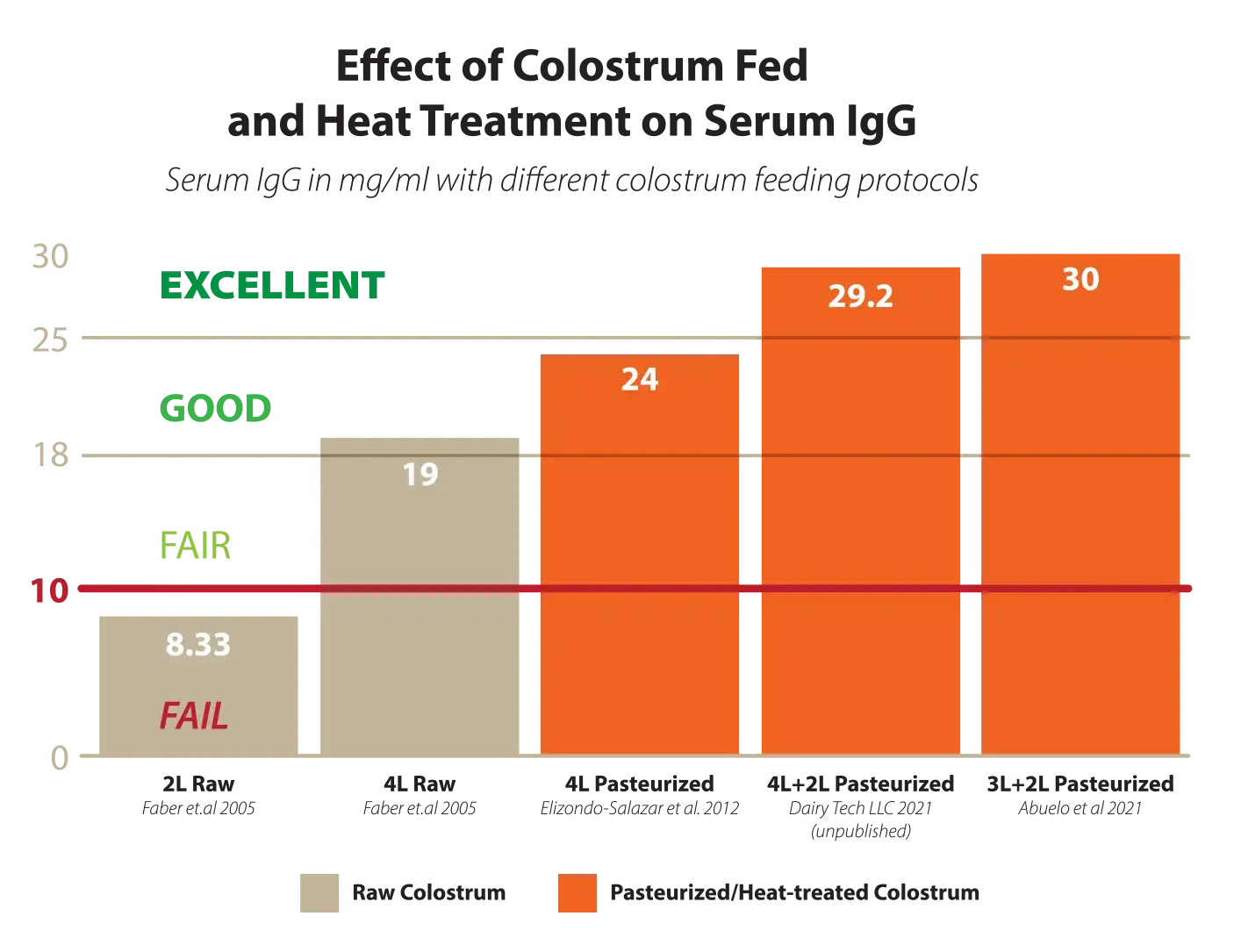
The impact of feeding volume becomes obvious when serum IgG outcomes are compared.
Programs based on a single two-liter feeding frequently produce serum IgG concentrations near the minimum acceptable range.
Increasing volume to four liters significantly improves passive transfer.
When high-quality pasteurized colostrum is fed in a two-feeding protocol totaling approximately five to six liters, average serum IgG concentrations commonly move into the Excellent category.
This distinction is important because the benefits continue long after the colostrum feeding period ends.
Are We Evaluating Our Colostrum Management Programs?
Despite the importance of passive transfer, routine monitoring remains underutilized on many dairies. The most recent national USDA survey reported that only 6.2% of operations routinely measured serum total protein concentrations to evaluate their colostrum management programs. Although adoption has likely increased over the past decade, national data remain limited, highlighting an important opportunity for the industry to place greater emphasis on measuring outcomes rather than simply assuming success.
Measuring passive transfer is the only way to know whether a colostrum program is truly working. Even well-designed protocols can fall short if colostrum quality varies, feeding volumes are inconsistent, calves are fed too late, or employees do not follow established procedures. Without routine monitoring, these problems often remain hidden.
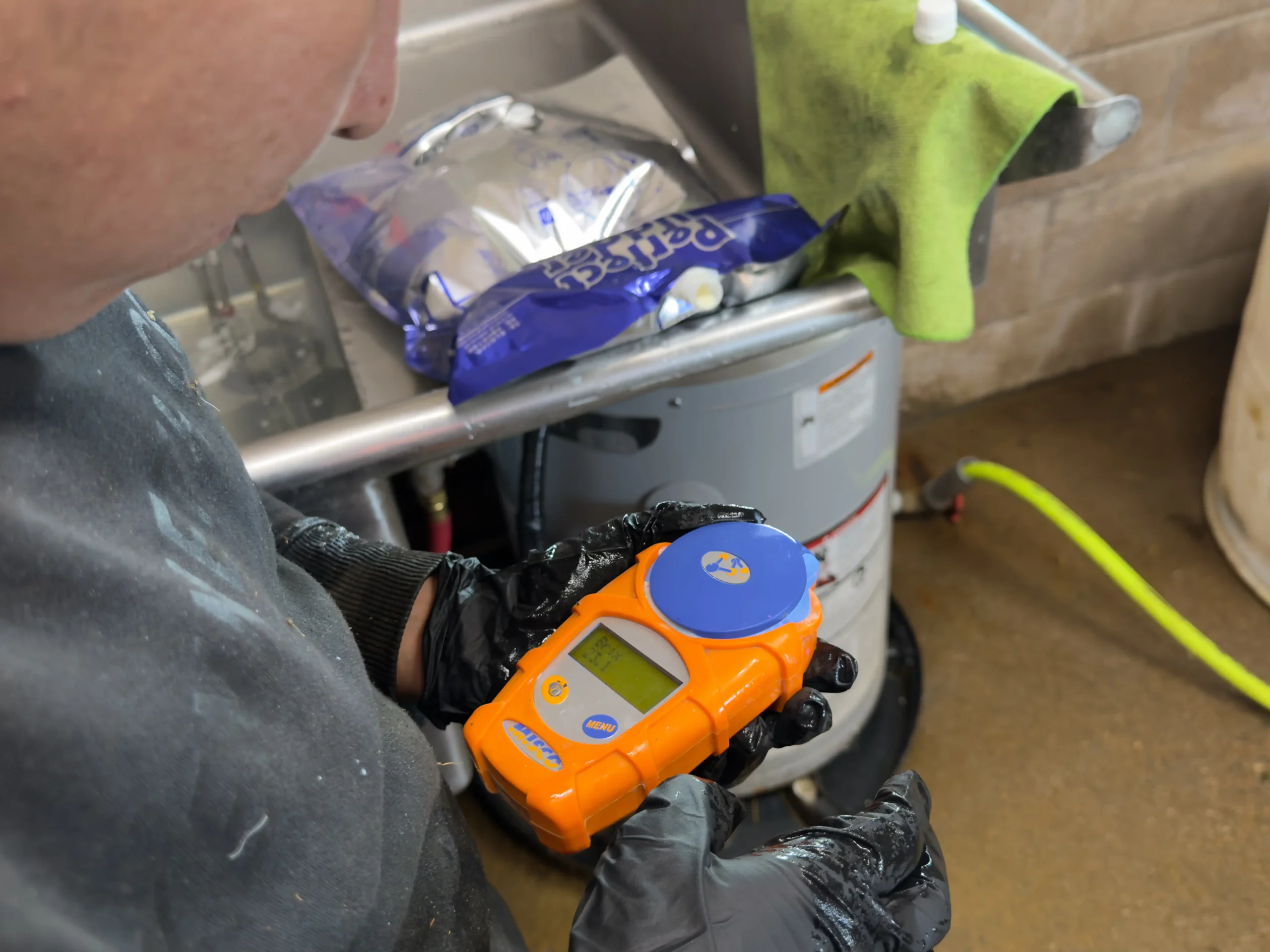
Serum total protein (STP) testing provides a simple, practical, and affordable way to verify that calves are receiving adequate immunity. Regular monitoring allows producers to identify trends, evaluate protocol compliance, and confirm that investments in colostrum management are producing measurable results.
Evaluating Your Colostrum Program Using Total Protein
A serum total protein (STP) test is one of the simplest and most effective ways to determine whether your colostrum program is working.
- Test healthy calves between 2 and 7 days of age.
- Collect a blood sample, centrifuge and measure serum total protein using a refractometer.
- Test at least 12 calves, but 20 or more provides greater confidence in the results. Testing every calf provides the most accurate measure of passive transfer success.
- Compare results to current industry benchmarks:
Excellent: ≥ 6.2 g/dL
Good: 5.8–6.1 g/dL
Fair: 5.2–5.7 g/dL
Poor: ≤ 5.1 g/dL
- Aim for at least 90% of calves in the Excellent category.
- Monitor results regularly to verify that your colostrum quality, feeding timing, and feeding volume are consistently achieving excellent passive transfer.
You can’t manage what you don’t measure. Routine STP testing is one of the best tools available to confirm that calves are receiving the immunity they need for a healthy start in life.
Long-Term Benefits of Excellent Passive Transfer
The benefits of excellent passive transfer extend well beyond the first weeks of life. Calves with higher serum IgG concentrations consistently experience lower disease rates, reduced mortality, improved growth, and greater lifetime productivity. Few management practices have such a profound and lasting impact on both animal welfare and economic performance. What happens on the first day of life can influence a calf for years to come.
Building a Repeatable System
The challenge for large dairies is rarely understanding the science. The challenge is executing it consistently.
Achieving excellent passive transfer requires systems that make the right outcome easy to achieve every day.
Successful programs focus on:
- Rapid collection after calving
- Quality testing of all colostrum
- Precision pasteurization
- Proper storage procedures
- Controlled warming protocols
- Timely delivery
- Adequate feeding volume
- Verification through routine serum total protein or Brix monitoring
When these steps are standardized, excellent passive transfer becomes predictable rather than accidental.
The Future of Colostrum Management
Some of the most exciting calf research being published today suggests that the benefits of colostrum may extend well beyond the first 24 hours of life. Historically, the industry’s focus has been almost exclusively on antibody absorption. Today, researchers are discovering that colostrum contains a wide range of growth factors, bioactive proteins, hormones, oligosaccharides, and other compounds that continue to influence intestinal development, immune function, and health long after gut closure occurs.
As a result, many progressive dairies are beginning to view transition milk and extended colostrum feeding as an extension of their passive transfer program rather than a separate feeding strategy. This rapidly evolving area of research deserves additional attention and will be explored in greater detail in future Dairy Tech articles.
The formula is simple: Quality. Quickness. Quantity.
When all three are optimized, calves enter life with stronger immunity, improved health, greater growth potential, and a better chance of reaching their full productive capacity.
Excellent passive transfer is no longer an aspirational goal. It is an achievable management standard for every dairy operation.